
| 45 min stirring at -70°C | 0-1 % |
| within 15 min to - 40°C | 39 % |
| 60 min stirring at -40°C | 50 % |
| 60 min stirring at -20°C | 76 % |
| 60 min stirring at 10°C | 100 % |
Mechanistic Suggestions
The same rearrangement can be induced by applying LDA on thienylethinyltrimethylsilane and warming up to RT. At first the influence of temperature on the rearrangement was examined:
| 45 min stirring at -70°C | 0-1 % |
| within 15 min to - 40°C | 39 % |
| 60 min stirring at -40°C | 50 % |
| 60 min stirring at -20°C | 76 % |
| 60 min stirring at 10°C | 100 % |
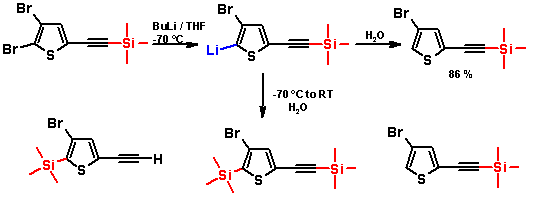
The reaction was repeated in DME and THF/TMEDA giving practically the same composition again - no significant influence by solvents could be established. The reaction was run again in THF/TMEDA for 1 h and for 5 hrs and analyzed via nmr quenching experiments:
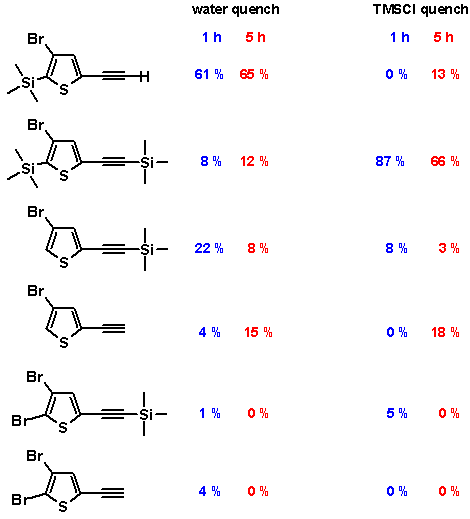
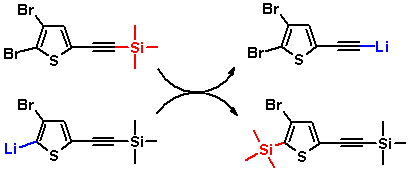
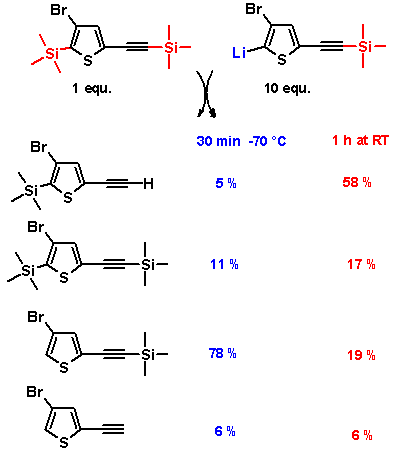
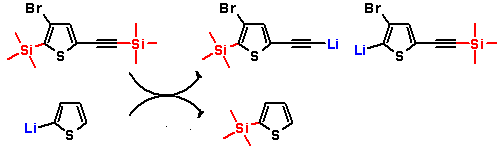
All the reactions depicted above - and very clearly the last one - show unambiguously that the whole reaction cascade and the reactivities of the substrates investigated can be clearly correlated with the different acidities of the corresponding thienyl and acetylene C-H-moieties. The bromine contributes due to its electron withdrawing property a stabilizing effect to the lithium-carbon bond compared to the unsubstituted product: this seems mainly to be the reason why the reaction reaches its equilibrium at ca. 60 % of the rearrangement target.
A good proof for this assumption is the successful migration discussed below: no ortho-bromo/lithium pattern is blocking
the reactivity of the lithium-carbon bond.
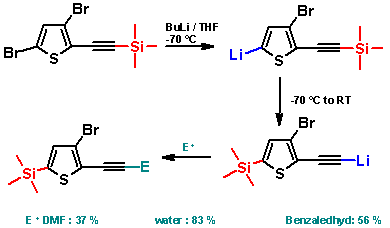
This example shows again that the ortho-vicinity of bromine and lithium atoms is the reason for the lower conversion rates during the rearrangement reaction.