Archive for the ‘Interesting chemistry’ Category
Monday, June 26th, 2017
About 18 months ago, there was much discussion on this blog about a system reported by Bob Pascal and co-workers containing a short H…H contact of ~1.5Å[1]. In this system, the hydrogens were both attached to Si as Si-H…H-Si and compressed together by rings. Now a new report[2] and commented upon by Steve Bachrach, claims a similar distance for hydrogens attached to carbon, i.e. C-H…H-C, but without the ring compression.
(more…)
References
- J. Zong, J.T. Mague, and R.A. Pascal, "Exceptional Steric Congestion in an <i>in</i>,<i>in</i>-Bis(hydrosilane)", Journal of the American Chemical Society, vol. 135, pp. 13235-13237, 2013. https://doi.org/10.1021/ja407398w
- S. Rösel, H. Quanz, C. Logemann, J. Becker, E. Mossou, L. Cañadillas-Delgado, E. Caldeweyher, S. Grimme, and P.R. Schreiner, "London Dispersion Enables the Shortest Intermolecular Hydrocarbon H···H Contact", Journal of the American Chemical Society, vol. 139, pp. 7428-7431, 2017. https://doi.org/10.1021/jacs.7b01879
Tags:10.1021, Blog, chemical shift, chemical shift difference, chemical shifts, gas phase, Oxygen, Steve Bachrach
Posted in Interesting chemistry | 3 Comments »
Sunday, April 9th, 2017
Both the cyclopropenium cation and the cyclopentadienide anion are well-known 4n+2-type aromatic ions, but could the two together form an ion-pair?
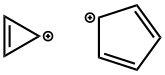
(more…)
Tags:Anions, Aromatization, Cation–pi interaction, Chemistry, Cyclopentadienyl anion, Ion, Ion association, potential energy surface, Simple aromatic rings
Posted in crystal_structure_mining, Interesting chemistry | 6 Comments »
Saturday, April 1st, 2017
In a comment appended to an earlier post, I mused about the magnitude of the force constant relating to the interconversion between a classical and a non-classical structure for the norbornyl cation. Most calculations indicate the force constant for an “isolated” symmetrical cation is +ve, which means it is a true minimum and not a transition state for a [1,2] shift. The latter would have been required if the species equilibrated between two classical carbocations. I then pondered what might happen to both the magnitude and the sign of this force constant if various layers of solvation and eventually a counter-ion were to be applied to the molecule, so that a bridge of sorts between the different states of solid crystals, superacid and aqueous solutions might be built.
(more…)
Tags:Carbocations, chemical bonding, Chemistry, constant matrix/search direction, continuum model for water, gas phase, Paul Schleyer, Physical organic chemistry, potential energy surface, Reactive intermediates, superacid and aqueous solutions
Posted in crystal_structure_mining, Interesting chemistry, reaction mechanism | 7 Comments »
Friday, March 31st, 2017
Occasionally one comes across a web site that manages to combine being unusual, interesting and also useful. Thus www.molinsight.net is I think a unique chemistry resource for blind and visually impaired students.
(more…)
Tags:Chemistry, Electromagnetic radiation, Infrared, Infrared spectroscopy, Multimodal interaction, Nuclear magnetic resonance, open source chemical structure editors, Sonification, spectroscopy, stereochemical utilities
Posted in Interesting chemistry | No Comments »
Saturday, March 25th, 2017
A few years back I followed a train of thought here which ended with hexacoordinate carbon, then a hypothesis rather than a demonstrated reality. That reality was recently confirmed via a crystal structure, DOI:10.5517/CCDC.CSD.CC1M71QM[1]. Here is a similar proposal for penta-coordinate nitrogen.
(more…)
References
- M. Malischewski, and K. Seppelt, "Crystal Structure Determination of the Pentagonal‐Pyramidal Hexamethylbenzene Dication C<sub>6</sub>(CH<sub>3</sub>)<sub>6</sub><sup>2+</sup>", Angewandte Chemie International Edition, vol. 56, pp. 368-370, 2016. https://doi.org/10.1002/anie.201608795
Tags:aromatic systems, Chemistry, Hexacoordinate, Hypotheses, Matter, Molecular geometry, Stereochemistry
Posted in Bond slam, crystal_structure_mining, Hypervalency, Interesting chemistry | 1 Comment »
Sunday, March 19th, 2017
The Wikipedia entry on peroxydisulfate is quite short (as of today). But I suspect this article may change things.[1].
(more…)
References
- M.A. Keller, D. Kampjut, S.A. Harrison, and M. Ralser, "Sulfate radicals enable a non-enzymatic Krebs cycle precursor", Nature Ecology & Evolution, vol. 1, 2017. https://doi.org/10.1038/s41559-017-0083
Tags:metal salts, Peroxydisulfate
Posted in crystal_structure_mining, Interesting chemistry | No Comments »
Sunday, March 12th, 2017
This is another of those posts that has morphed from an earlier one noting the death of the great chemist George Olah. The discussion about the norbornyl cation concentrated on whether this species existed in a single minimum symmetric energy well (the non-classical Winstein/Olah proposal) or a double minimum well connected by a symmetric transition state (the classical Brown proposal). In a comment on the post, I added other examples in chemistry of single/double minima, mapped here to non-classical/classical structures. I now expand on the examples related to small aromatic or anti-aromatic rings.
(more…)
Tags:antiaromaticity, aromaticity, Évariste Galois, Carbocation, Chemistry, equilibrium minimum energy position, George Andrew Olah, George Olah, great chemist, Jahn-Teller, minimum symmetric energy, Olah, Physical organic chemistry, Saul Winstein, symmetric energy potentials
Posted in Interesting chemistry | No Comments »
Friday, March 10th, 2017
George Olah passed away on March 8th. He was part of the generation of scientists in the post-war 1950s who had access to chemical instrumentation that truly revolutionised chemistry. In particular he showed how the then newly available NMR spectroscopy illuminated structures of cations in solvents such “Magic acid“. The obituaries will probably mention his famous “feud” with H. C. Brown over the structure of the norbornyl cation (X=CH2+), implicated in the mechanism of many a solvolysis reaction that characterised the golden period of physical organic chemistry just before and after WWII.
(more…)
Tags:2-Norbornyl cation, aqueous solutions, Chemical bond, chemical instrumentation, Chemistry, George Andrew Olah, George Olah, Ion association, Magic acid, Michael Dewar, Molecule, Nature, Physical organic chemistry, Reactive intermediates, spectroscopy
Posted in Interesting chemistry | 17 Comments »
Thursday, March 2nd, 2017
The thread thus far. The post about Na2He introduced the electride anionic counter-ion to Na+ as corresponding topologically to a rare feature known as a non-nuclear attractor. This prompted speculation about other systems with such a feature, and the focus shifted to a tetrahedral arrangement of four hydrogen atoms as a dication, sharing a total of two valence electrons. The story now continues here.
(more…)
Tags:chemical bonding, Chemistry, Electride, free energy, Ion, Nature, Physical chemistry, Valence electron
Posted in Interesting chemistry | 1 Comment »
Wednesday, February 15th, 2017
This post arose from a comment attached to the post on Na2He and relating to peculiar and rare topological features of the electron density in molecules called non-nuclear attractors. This set me thinking about other molecules that might exhibit this and one of these is shown below.
(more…)
Tags:Attractor, brief search, Chemistry, Electron, Electron density, Hydrogen, Molecule, Nature, Physics, Quantum chemistry
Posted in Interesting chemistry | 11 Comments »