Archive for the ‘Interesting chemistry’ Category
Friday, April 15th, 2016
In the previous post I described how hydronium hydroxide or H3O+…HO–, an intermolecular tautomer of water, has recently been observed captured inside an organic cage[1] and how the free-standing species in water can be captured computationally with the help of solvating water bridges. Here I explore azane oxide or H3N+-O–,‡ a tautomer of the better known hydroxylamine (H2N-OH).
(more…)
References
- M. Stapf, W. Seichter, and M. Mazik, "Unique Hydrogen‐Bonded Complex of Hydronium and Hydroxide Ions", Chemistry – A European Journal, vol. 21, pp. 6350-6354, 2015. https://doi.org/10.1002/chem.201406383
Tags:Ammonia, aqueous solutions, Bases, energy relative, free energy, Functional groups, Hydrogen bond, Hydronium, Hydroxides, Hydroxyl, Hydroxylamine, lowest energy form, Properties of water, Reducing agents, Self-ionization of water
Posted in General, Interesting chemistry | No Comments »
Thursday, April 14th, 2016
Ammonium hydroxide (NH4+…OH–) can be characterised quantum mechanically when stabilised by water bridges connecting the ion-pairs. It is a small step from there to hydronium hydroxide, or H3O+…OH–. The measured concentrations [H3O+] ≡ [OH–] give rise of course to the well-known pH 7 of pure water, and converting this ionization constant to a free energy indicates that the solvated ion-pair must be some ~19.1 kcal/mol higher in free energy than water itself.♣ So can a quantum calculation reproduce pH7 for water?
(more…)
Tags:Acid dissociation constant, Acids, Cations, chemical bonding, energy, Equilibrium chemistry, free energy, Hydride, Hydrogen bond, Hydronium, Hydroxide, Physical chemistry, Properties of water, self-ionization energy, Self-ionization of water
Posted in General, Interesting chemistry | 3 Comments »
Friday, April 8th, 2016
Previously, I looked at models of how ammonia could be protonated by water to form ammonium hydroxide. The energetic outcome of my model matched the known equilbrium in water as favouring the unprotonated form (pKb ~4.75). I add here two amines for which R=Me3Si and R=CN. The idea is that the first will assist nitrogen protonation by stabilising the positive centre and the second will act in the opposite sense; an exploration if you like of how one might go about computationally designing a non-steric superbasic amine that becomes predominantly protonated when exposed to water (pKb <1)† and is thus more basic than hydroxide anion in this medium.
(more…)
Tags:Acid, Acid dissociation constant, Amide, Amine, Ammonia, Ammonium, Bases, City: Cambridge, energy, from non-protic solution, Functional groups, Hydrogen bond, Hydroxide, Lone pair, metal, Nitrile, relative free energy, search query
Posted in General, Interesting chemistry | 2 Comments »
Saturday, April 2nd, 2016
A celebration of the life and work of the great chemist Paul von R. Schleyer was held this week in Erlangen, Germany. There were many fantastic talks given by some great chemists describing fascinating chemistry. Here I highlight the presentation given by Andy Streitwieser on the topic of organolithium chemistry, also a great interest of Schleyer's over the years. I single this talk out since I hope it illustrates why people still get together in person to talk about science.
(more…)
Tags:Centroid, chemical effect, chemical insights, chemical interpretation, City: Erlangen, Country: Germany, Degree of a continuous mapping, Ferrocene, Hydrogen bond, individual search definition, metal, overall search collection, Streitwieser, terminal H-positions, Torsion, X-ray
Posted in Chemical IT, crystal_structure_mining, Interesting chemistry | 6 Comments »
Wednesday, February 24th, 2016
At the precise moment I write this, there is information about 108,230,950 organic and inorganic chemical substances from the World's disclosed chemistry. So it was with a sense of curiosity that I came across this article in the American Mineralogist[1] entitled "Earth’s “missing” minerals" (the first in a series of articles apparently planned on the topic of the missing ones). The abstract is particularly interesting and whilst I encourage you to go read the article itself, I will quote some eye-catching observations from just this abstract:
(more…)
References
- R.M. Hazen, G. Hystad, R.T. Downs, J.J. Golden, A.J. Pires, and E.S. Grew, "Earth’s “missing” minerals", American Mineralogist, vol. 100, pp. 2344-2347, 2015. https://doi.org/10.2138/am-2015-5417
Tags:inorganic chemical substances, Mineral, Mineralogist, natural products
Posted in Interesting chemistry | No Comments »
Sunday, January 31st, 2016
Six years ago, I posted on the nature of a then recently reported[1] Cr-Cr quintuple bond. The topic resurfaced as part of the discussion on a more recent post on NSF3, and a sub-topic on the nature of the higher order bonding in C2. The comment made a connection between that discussion and the Cr-Cr bond alluded to above. I responded briefly to that comment, but because I want to include 3D rotatable surfaces, I expand the discussion here and not in the comment.‡
(more…)
References
- C. Hsu, J. Yu, C. Yen, G. Lee, Y. Wang, and Y. Tsai, "Quintuply‐Bonded Dichromium(I) Complexes Featuring Metal–Metal Bond Lengths of 1.74 Å", Angewandte Chemie International Edition, vol. 47, pp. 9933-9936, 2008. https://doi.org/10.1002/anie.200803859
Tags:Chemical bond, chemical bonding, Electron, Electron configuration, energy, Molecular orbital, Multi-configurational self-consistent field, Quantum chemistry, quintuple bond, search term, Transition metal, Valence bond theory
Posted in General, Interesting chemistry | 6 Comments »
Sunday, January 10th, 2016
Earlier I explored models for the heteroaromatic electrophilic protiodecarboxylation of an 3-substituted indole, focusing on the role of water as the proton transfer and delivery agent. Next, came models for both water and the general base catalysed ionization of indolinones. Here I explore general acid catalysis by evaluating the properties of two possible models for decarboxylation of 3-indole carboxylic acid, one involving proton transfer (PT) from neutral water in the presence of covalent un-ionized HCl (1) and one with PT from a protonated water resulting from ionised HCl (2).
(more…)
Tags:Acid, Acids, bicyclic network, carboxylic acid, free energy, Functional groups, Hydrogen bond, Indole, transition state free energy
Posted in Interesting chemistry | 1 Comment »
Thursday, December 24th, 2015
The BBC TV quiz series Mastermind was first broadcast in the UK in 1972, the same time I was starting to investigate the mechanism of diazocoupling to substituted indoles as part of my Ph.D. researches. The BBC program became known for the catch phrase I've started so I'll finish; here I will try to follow this precept with the project I started then. 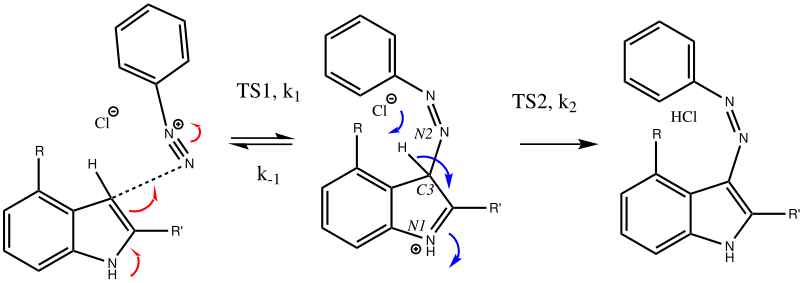 In 1972, one measured the rates of chemical reactions to gain insights into the transition state kinetic model. To obtain more data, we used isotopes such as 2H or 3H, together with substituents such as R-t-butyl to modify the potential energy surfaces of the reactions by inducing steric effects.[1],[2] We found that the kinetics for this reaction were actually complex‡ (in part because of pH dependence) involving a Wheland intermediate (the formation of which is shown with red curly arrows above) followed by the collapse of this intermediate to the diazo-coupled product (blue arrows). Coupling to 2-methyl indole (R=X=H, R'=Me), 2-t-butyl indole (R=H, R'=t-butyl) and 4-methyl-2-t-butyl indole (R=Me, R'=t-butyl) revealed that the kinetic isotope effects induced by replacing H by D or T were "not apparent" (i.e. close to 1), the inference being that the rate constant k1 for those systems was slower than k2; the formation of the Wheland intermediate was rate determining (the rds) for the reaction. But with 2-methyl-4,6-di-t-butyl indole (R=t-butyl, R'=Me) this changed and a deuterium isotope effect of ~7 was observed. The rate determining proton removal from the Wheland intermediate k2 was now slower than k1. With 2,4,6-tri-t-butyl indole, we ended by noting that the reaction become almost too slow to observe and furthermore was accompanied by loss of a t-butyl cation as well as a proton. At this point we attempted to infer some transition state models consistent with these observations. Note that we had relatively little data with which to derive our 3D models (one needs to define a geometry using 3N-6 variables, along with its relative energy and force constants). The text and diagram of our attempt is shown below.
 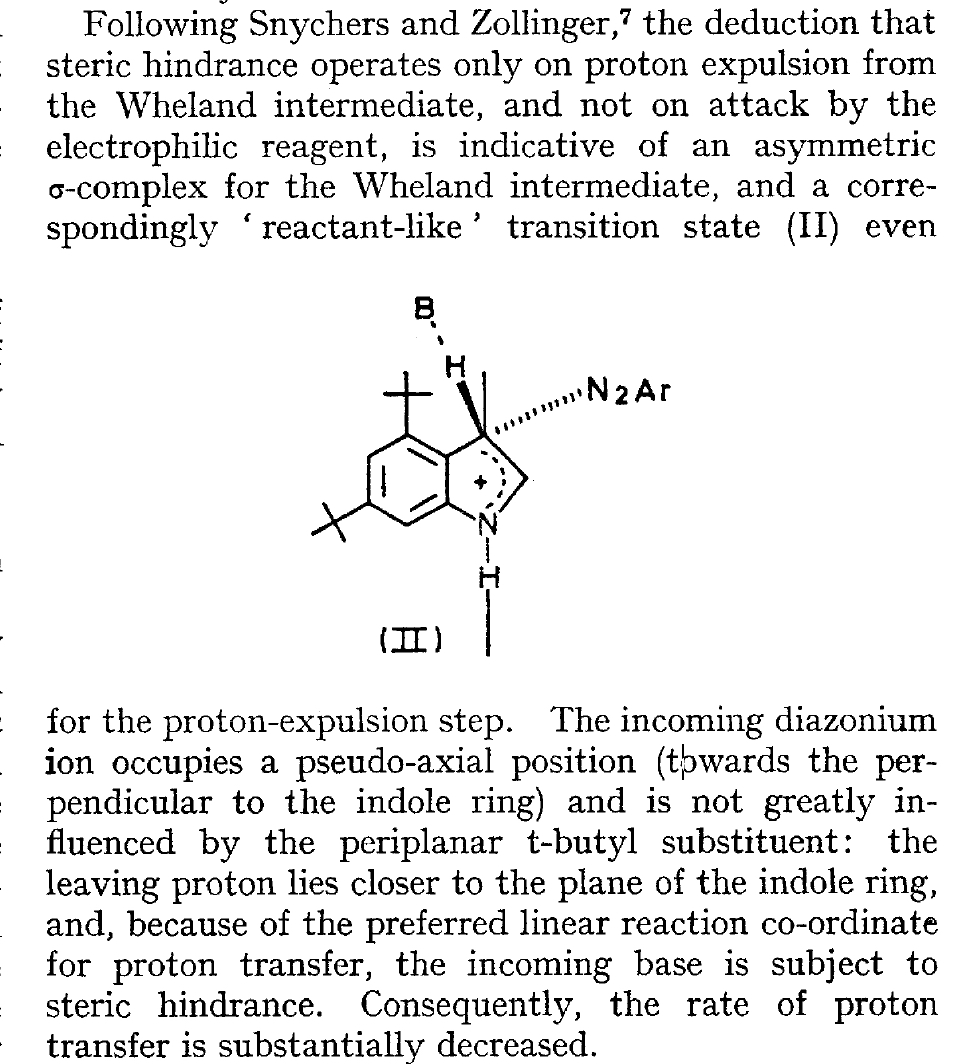 The main points of this argument were;
(more…)
References
- B.C. Challis, and H.S. Rzepa, "The mechanism of diazo-coupling to indoles and the effect of steric hindrance on the rate-limiting step", Journal of the Chemical Society, Perkin Transactions 2, pp. 1209, 1975. https://doi.org/10.1039/p29750001209
- H.S. Rzepa, "Hydrogen transfer reactions of Indoles", 1974. https://doi.org/10.5281/zenodo.18777
Tags:Butyl, chemical reactions, Indole, Kinetic isotope effect, Organic chemistry, Physical organic chemistry, potential energy surfaces, relative energy
Posted in Historical, Interesting chemistry, reaction mechanism | 1 Comment »
Friday, December 11th, 2015
You might have noticed the occasional reference here to the upcoming centenary of the publication of Gilbert N. Lewis’ famous article entitled “The atom and the molecule“.[1] A symposium exploring his scientific impact and legacy will be held in London on March 23, 2016, exactly 70 years to the day since his death. A list of the speakers and their titles is shown below; there is no attendance fee, but you must register as per the instructions below.
(more…)
References
- G.N. Lewis, "THE ATOM AND THE MOLECULE.", Journal of the American Chemical Society, vol. 38, pp. 762-785, 1916. https://doi.org/10.1021/ja02261a002
Tags:Alan Dronsfield, Clark Landis, Durham, France, Gilbert N. Lewis, John Nicholson, Julia Contreras-Garcia, Liverpool, London, Michael Mingos, Nick Greeves, organic chemist, Oxford, Patrick Coffey, professor, Robin Hendry, Royal Society of Chemistry Historical Group, United Kingdom, United States
Posted in Interesting chemistry | 1 Comment »