Archive for the ‘Interesting chemistry’ Category
Friday, September 27th, 2019
In the previous posts, I tried to track down the onset of bond length alternation (BLA) as a function of ring size in aromatic cyclocarbons, finding the answer varied dramatically depending on the type of method used to calculate it. So here I change the system to an unusual kind of aromatic ring, the leminiscular or figure-eight annulene series.♥ I explore the Kekulé vibration for such species for which a 4n+2 π electron count means they are cyclically Möbius aromatic.[1]
(more…)
References
- P.L. Ayers, R.J. Boyd, P. Bultinck, M. Caffarel, R. Carbó-Dorca, M. Causá, J. Cioslowski, J. Contreras-Garcia, D.L. Cooper, P. Coppens, C. Gatti, S. Grabowsky, P. Lazzeretti, P. Macchi, Ã. Martín Pendás, P.L. Popelier, K. Ruedenberg, H. Rzepa, A. Savin, A. Sax, W.E. Schwarz, S. Shahbazian, B. Silvi, M. Solà, and V. Tsirelson, "Six questions on topology in theoretical chemistry", Computational and Theoretical Chemistry, vol. 1053, pp. 2-16, 2015. https://doi.org/10.1016/j.comptc.2014.09.028
Posted in Interesting chemistry | 2 Comments »
Tuesday, September 3rd, 2019
In the previous post, I looked at the so-called Kekulé vibration of cyclo[18]carbon using various quantum methods and basis sets. Because some of these procedures can take a very long time, I could not compare them using the same high-quality consistent atom basis set for the carbon (Def2-TZVPP). Here I try to start to do this using the smaller six and ten carbon rings to see what trends might emerge. FAIR data are at DOI: 10.14469/hpc/6069
(more…)
Posted in Interesting chemistry | 2 Comments »
Friday, August 30th, 2019
I have discussed the vibration in benzene known as the Kekulé mode in other posts, the first of which was all of ten years ago. It is a stretching mode that lengthens three of the bonds in benzene (a [6]-annulene) and shortens the other three, thus leading to a cyclohexatriene motif (see below). This vibration is real (+ve force constant) in benzene itself, which indicates that distorting the structure from six to three-fold symmetry leads to an increase in energy. Benzene therefore has a symmetrising influence, and it comes as a surprise to most to learn that this is actually due to the σ rather than the π-electrons! But there are good reasons to believe that as the ring size of the annulene increases, the Kekulé vibration will evolve from a real mode into an imaginary (-ve force constant) vibration representing a transition state for mutating the single and double bonds. At some point therefore, the more symmetrical geometry of the annulene in which all the bonds are of equal length will change into one of lower symmetry, in which BLA (bond length alternation) occurs and the symmetrical form becomes a transition state for this process.
(more…)
Posted in Interesting chemistry | No Comments »
Sunday, August 4th, 2019
In the pipeline reports on an intriguing new ring system acting as an isostere for morpholine. I was interested in how the conformation of this ring system might be rationalised electronically and so I delved into the article.[1] Here I recount what I found.
(more…)
References
- H. Hobbs, G. Bravi, I. Campbell, M. Convery, H. Davies, G. Inglis, S. Pal, S. Peace, J. Redmond, and D. Summers, "Discovery of 3-Oxabicyclo[4.1.0]heptane, a Non-nitrogen Containing Morpholine Isostere, and Its Application in Novel Inhibitors of the PI3K-AKT-mTOR Pathway", Journal of Medicinal Chemistry, vol. 62, pp. 6972-6984, 2019. https://doi.org/10.1021/acs.jmedchem.9b00348
Posted in Chemical IT, Interesting chemistry | 6 Comments »
Saturday, June 15th, 2019
The World-Wide-Web is currently celebrating its 30th anniversary; you can get the T-shirt in the CERN visitor centre! Five years on, in May 1994, the first Web conference took place (WWW94) at CERN and now celebrating its own 25th anniversary. That 1994 conference also had various break-out sessions, one of which summarised the state of chemistry on the web at the time. You can see my general but entirely personal impressions written after the workshop (DOI: 10.14469/hpc/5850), with a chemistry specific version at DOI: 10.14469/hpc/5851. A real trip down memory lane and an indication of how much has happened in 25 years!
(more…)
Posted in Interesting chemistry | 1 Comment »
Wednesday, June 5th, 2019
In August 2016, the launch of a chemistry pre-print service ChemRxiv was announced. I was phoned a day or so later by a staff journalist at C&E News for my opinion. The only comment that was retained for their report was my instantaneous feeling that “the community needed a chemistry pre-print server like one needed a hole in the head“. I had been there before you see, recollecting a pre-print server launched by the ChemWeb service around 1996 or 1997 and which lasted only about two years before being withdrawn due to the low quality of the preprints. So what do I think of ChemRxiv now in 2019?
(more…)
Posted in Interesting chemistry | 14 Comments »
Sunday, June 2nd, 2019
This is a follow up to my earlier post about C⩸N+, itself inspired by this ChemRxiv pre-print[1] which describes a chemical synthesis of singlet biradicaloid C2 and its proposed identification as such by chemical trapping.
(more…)
References
- K. Miyamoto, S. Narita, Y. Masumoto, T. Hashishin, M. Kimura, M. Ochiai, and M. Uchiyama, "Room-Temperature Chemical Synthesis of C2", 2019. https://doi.org/10.26434/chemrxiv.8009633.v1
Posted in Interesting chemistry | No Comments »
Monday, May 27th, 2019
Although the small diatomic molecule known as dicarbon or C2 has been known for a long time, its properties and reactivity have really only been determined via its very high temperature generation. My interest started in 2010, when I speculatively proposed here that the related isoelectronic species C⩸N+ might sustain a quadruple bond. Shortly thereafter, a torrent of theoretical articles started to appear in which the idea of a quadruple bond to carbon was either supported or rejected. Clearly more experimental evidence was needed. The recent appearance of a Chemrxiv pre-print entitled “Room-temperature chemical synthesis of C2“.[1] claims to provide just this! Using the synthetic scheme outlined below, they trapped “C2” with a variety of reagents (see Figure 2A in their article), concluding that the observed reactivity best matched that of singlet “biradicaloid” C2 sustaining a quadruple bond.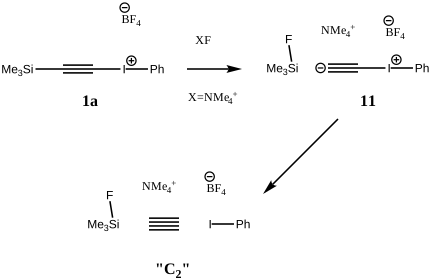
(more…)
References
- K. Miyamoto, S. Narita, Y. Masumoto, T. Hashishin, M. Kimura, M. Ochiai, and M. Uchiyama, "Room-Temperature Chemical Synthesis of C2", 2019. https://doi.org/10.26434/chemrxiv.8009633.v1
Posted in Interesting chemistry | 6 Comments »
Thursday, April 25th, 2019
Previously, I explored (computationally) the normal vibrational modes of Co(II)-tetraphenylporphyrin (CoTPP) as a “flattened” species on copper or gold surfaces for comparison with those recently imaged[1]. The initial intent was to estimate the “flattening” energy. There are six electronic possibilities for this molecule on a metal surface. Respectively positively, or negatively charged and a neutral species, each in either a low or a high-spin electronic state. I reported five of these earlier, finding each had quite high barriers for “flattening” the molecule. For the final 6th possibility, the triplet anion, the SCF (self-consistent-field) had failed to converge, but for which I can now report converged results.†
(more…)
References
- J. Lee, K.T. Crampton, N. Tallarida, and V.A. Apkarian, "Visualizing vibrational normal modes of a single molecule with atomically confined light", Nature, vol. 568, pp. 78-82, 2019. https://doi.org/10.1038/s41586-019-1059-9
Tags:019-1059-9, 10.1038, Biomolecules, Chelating agents, chemical bonding, Chemical compounds, Chemistry, Coordination chemistry, Coordination complex, Copper, copper metal surface, Cu–CO, E-type, energy, free energy, higher energy, impossible free energy, Inorganic chemistry, Jahn–Teller effect, lowest energy electronic state, Metabolism, metal, metal surface, modest planarisation energy, Molecule, Natural sciences, Physical sciences, planarisation, Porphyrin, reasonable energy, Resonance, Solid-state chemistry, sufficient energy, Teller, Tetraphenylporphyrin
Posted in Interesting chemistry | 1 Comment »
Thursday, April 18th, 2019
The topic of this post originates from a recent article which is attracting much attention.[1] The technique uses confined light to both increase the spatial resolution by around three orders of magnitude and also to amplify the signal from individual molecules to the point it can be recorded. To me, Figure 3 in this article summarises it nicely (caption: visualization of vibrational normal modes). Here I intend to show selected modes as animated and rotatable 3D models with the help of their calculation using density functional theory (a mode of presentation that the confinement of Figure 3 to the pages of a conventional journal article does not enable).
(more…)
References
- J. Lee, K.T. Crampton, N. Tallarida, and V.A. Apkarian, "Visualizing vibrational normal modes of a single molecule with atomically confined light", Nature, vol. 568, pp. 78-82, 2019. https://doi.org/10.1038/s41586-019-1059-9
Tags:anionic metal surface, Cambridge, chemical bonding, Chemistry, dihedral, energy, flat metal surface, metal, Natural sciences, Neutral Quartet, Physical sciences, Raman scattering, Raman spectroscopy, Resonance, spectroscopy, steric repulsion energy
Posted in Interesting chemistry | No Comments »