Archive for the ‘Interesting chemistry’ Category
Saturday, November 23rd, 2013
Mercury (IV) tetrafluoride attracted much interest when it was reported in 2007[1] as the first instance of the metal being induced to act as a proper transition element (utilising d-electrons for bonding) rather than a post-transition main group metal (utilising just s-electrons) for which the HgF2 dihalide would be more normal (“Is mercury now a transition element?”[2]). Perhaps this is the modern equivalent of transmutation! Well, now we have new speculation about how to induce the same sort of behaviour for caesium; might it form CsF3 (at high pressures) rather than the CsF we would be more familiar with.[3] Here I report some further calculations inspired by this report.
(more…)
References
- X. Wang, L. Andrews, S. Riedel, and M. Kaupp, "Mercury Is a Transition Metal: The First Experimental Evidence for HgF<sub>4</sub>", Angewandte Chemie International Edition, vol. 46, pp. 8371-8375, 2007. https://doi.org/10.1002/anie.200703710
- M. Miao, "Caesium in high oxidation states and as a p-block element", Nature Chemistry, vol. 5, pp. 846-852, 2013. https://doi.org/10.1038/nchem.1754
Tags:animation, energy, free energy barrier, free energy change, metal, pence, post-transition main group metal, potential energy surface
Posted in Hypervalency, Interesting chemistry | 13 Comments »
Saturday, October 26th, 2013
The 1H NMR spectrum of an aromatic molecule such as benzene is iconic; one learns that the unusual chemical shift of the protons (~δ 7-8 ppm) is due to their deshielding by a diatropic ring current resulting from the circulation of six aromatic π-electrons following the Hückel 4n+2 rule. But rather less well-known is the spectacular inversion of these effects as induced by the paratropic circulation of 4n electrons. A 4n+2 rule can be converted to a 4n one by the addition of two electrons, and chemically this can be done by reduction with lithium metal to form a dianion. Fortunately, this experiment has been done for a molecule known as methano[10]annulene. This is a 4n+2 aromatic molecule 1 with ten π-electrons (n=2) that can be reduced with lithium metal to form an ion-pair 2 comprising lithium cations and the twelve π-electron (4n, n=3) methano[10]annulene dianion.[1]
(more…)
References
- D. Schmalz, and H. Günther, "1,6‐Methano[10]annulene Dianion, a Paratropic 12π‐Electron Dianion with a C<sub>10</sub> Perimeter", Angewandte Chemie International Edition in English, vol. 27, pp. 1692-1693, 1988. https://doi.org/10.1002/anie.198816921
Tags:chemical shifts, lithium metal, unusual chemical shift
Posted in Interesting chemistry | No Comments »
Sunday, October 20th, 2013
Homoaromaticity is a special case of aromaticity in which π-conjugation is interrupted by a single sp3 hybridized carbon atom (it is sometimes referred to as a suspended π-bond with no underlying σ-foundation). But consider the carbene shown below. This example comes from a recently published article[1] which was highlighted on Steve Bachrach’s blog. Here aromaticity has resulted from a slightly different phenomenon, whereby a 4π-electron planar (and hence nominally anti-aromatic) molecule is elevated to aromatic peerage by promoting the two carbene σ-electrons to have π-status.
(more…)
References
- B. Chen, A.Y. Rogachev, D.A. Hrovat, R. Hoffmann, and W.T. Borden, "How to Make the σ<sup>0</sup>π<sup>2</sup> Singlet the Ground State of Carbenes", Journal of the American Chemical Society, vol. 135, pp. 13954-13964, 2013. https://doi.org/10.1021/ja407116e
Tags:low energy, Steve Bachrach
Posted in Interesting chemistry | 1 Comment »
Wednesday, October 2nd, 2013
This is a continuation of the discussion started on Steve Bachrach’s blog about a molecule with a very short H…H interaction involving two Si-H groups with enforced proximity. It had been inferred from the X-ray structure[1] that the H…H distance was in the region of 1.50Å. It’s that cis-butene all over again! So is that H…H region a bond? Is it attractive or repulsive? Go read Steve’s blog first.
(more…)
References
- J. Zong, J.T. Mague, and R.A. Pascal, "Exceptional Steric Congestion in an <i>in</i>,<i>in</i>-Bis(hydrosilane)", Journal of the American Chemical Society, vol. 135, pp. 13235-13237, 2013. https://doi.org/10.1021/ja407398w
Tags:Postscript, Steve Bachrach, X-ray
Posted in Interesting chemistry | 17 Comments »
Saturday, September 21st, 2013
The best known example of the gauche effect is 1,2-difluoroethane, which exhibits a relatively small preference of ~0.5 kcal/mol for this conformer over the anti orientation, which is also a minimum. But FSSF, which I discussed in the previous post, beats this hands down! It also, by the way, must surely be the smallest molecule (only four atoms) which could be theoretically resolved into two enantiomers (possibly at say 273K?).‡
(more…)
Tags:ELF, Transition state
Posted in Interesting chemistry, reaction mechanism | 2 Comments »
Thursday, September 19th, 2013
Paul Schleyer sent me an email about a pattern he had spotted, between my post on F3SSF and some work he and Michael Mauksch had done 13 years ago with the intriguing title “Demonstration of Chiral Enantiomerization in a Four-Atom Molecule“.[1] Let me explain the connection, but also to follow-up further on what I discovered in that post and how a new connection evolved.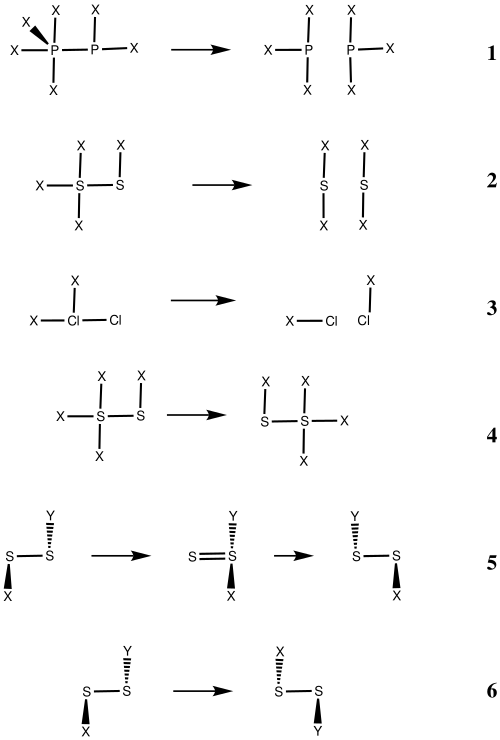
(more…)
References
Tags:energy, energy profile, head, low energy barrier, lowest energy route, Michael Mauksch, Paul Schleyer, reactant/product
Posted in Interesting chemistry | 3 Comments »
Sunday, September 15th, 2013
I do go on rather a lot about enabling or hyper-activating[1] data. So do others[2]. Why is sharing data important?
(more…)
References
- O. Casher, G.K. Chandramohan, M.J. Hargreaves, C. Leach, P. Murray-Rust, H.S. Rzepa, R. Sayle, and B.J. Whitaker, "Hyperactive molecules and the World-Wide-Web information system", Journal of the Chemical Society, Perkin Transactions 2, pp. 7, 1995. https://doi.org/10.1039/p29950000007
- R. Van Noorden, "Data-sharing: Everything on display", Nature, vol. 500, pp. 243-245, 2013. https://doi.org/10.1038/nj7461-243a
Tags:chemical tagger, data mining, datument, David Scheschkewitz, e-notebook, Google, opendata, Peter Murray-Rust, pre-processor, researcher, scientific tool, supervisor, United Kingdom
Posted in Chemical IT, Interesting chemistry | 9 Comments »