Archive for the ‘Interesting chemistry’ Category
Sunday, October 20th, 2013
Homoaromaticity is a special case of aromaticity in which π-conjugation is interrupted by a single sp3 hybridized carbon atom (it is sometimes referred to as a suspended π-bond with no underlying σ-foundation). But consider the carbene shown below. This example comes from a recently published article[1] which was highlighted on Steve Bachrach’s blog. Here aromaticity has resulted from a slightly different phenomenon, whereby a 4π-electron planar (and hence nominally anti-aromatic) molecule is elevated to aromatic peerage by promoting the two carbene σ-electrons to have π-status.
(more…)
References
- B. Chen, A.Y. Rogachev, D.A. Hrovat, R. Hoffmann, and W.T. Borden, "How to Make the σ<sup>0</sup>π<sup>2</sup> Singlet the Ground State of Carbenes", Journal of the American Chemical Society, vol. 135, pp. 13954-13964, 2013. https://doi.org/10.1021/ja407116e
Tags:low energy, Steve Bachrach
Posted in Interesting chemistry | 1 Comment »
Wednesday, October 2nd, 2013
This is a continuation of the discussion started on Steve Bachrach’s blog about a molecule with a very short H…H interaction involving two Si-H groups with enforced proximity. It had been inferred from the X-ray structure[1] that the H…H distance was in the region of 1.50Å. It’s that cis-butene all over again! So is that H…H region a bond? Is it attractive or repulsive? Go read Steve’s blog first.
(more…)
References
- J. Zong, J.T. Mague, and R.A. Pascal, "Exceptional Steric Congestion in an <i>in</i>,<i>in</i>-Bis(hydrosilane)", Journal of the American Chemical Society, vol. 135, pp. 13235-13237, 2013. https://doi.org/10.1021/ja407398w
Tags:Postscript, Steve Bachrach, X-ray
Posted in Interesting chemistry | 17 Comments »
Saturday, September 21st, 2013
The best known example of the gauche effect is 1,2-difluoroethane, which exhibits a relatively small preference of ~0.5 kcal/mol for this conformer over the anti orientation, which is also a minimum. But FSSF, which I discussed in the previous post, beats this hands down! It also, by the way, must surely be the smallest molecule (only four atoms) which could be theoretically resolved into two enantiomers (possibly at say 273K?).‡
(more…)
Tags:ELF, Transition state
Posted in Interesting chemistry, reaction mechanism | 2 Comments »
Thursday, September 19th, 2013
Paul Schleyer sent me an email about a pattern he had spotted, between my post on F3SSF and some work he and Michael Mauksch had done 13 years ago with the intriguing title “Demonstration of Chiral Enantiomerization in a Four-Atom Molecule“.[1] Let me explain the connection, but also to follow-up further on what I discovered in that post and how a new connection evolved.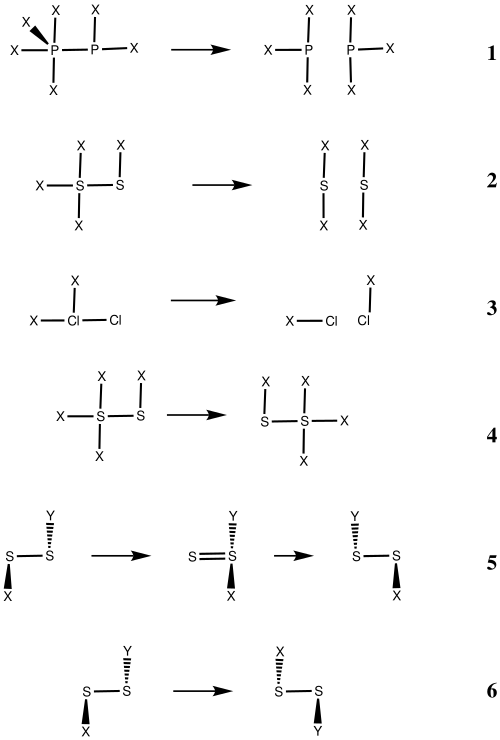
(more…)
References
Tags:energy, energy profile, head, low energy barrier, lowest energy route, Michael Mauksch, Paul Schleyer, reactant/product
Posted in Interesting chemistry | 3 Comments »
Sunday, September 15th, 2013
I do go on rather a lot about enabling or hyper-activating[1] data. So do others[2]. Why is sharing data important?
(more…)
References
- O. Casher, G.K. Chandramohan, M.J. Hargreaves, C. Leach, P. Murray-Rust, H.S. Rzepa, R. Sayle, and B.J. Whitaker, "Hyperactive molecules and the World-Wide-Web information system", Journal of the Chemical Society, Perkin Transactions 2, pp. 7, 1995. https://doi.org/10.1039/p29950000007
- R. Van Noorden, "Data-sharing: Everything on display", Nature, vol. 500, pp. 243-245, 2013. https://doi.org/10.1038/nj7461-243a
Tags:chemical tagger, data mining, datument, David Scheschkewitz, e-notebook, Google, opendata, Peter Murray-Rust, pre-processor, researcher, scientific tool, supervisor, United Kingdom
Posted in Chemical IT, Interesting chemistry | 9 Comments »
Thursday, September 12th, 2013
Andy Extance at the Chemistry World blog has picked up on a fascinating article[1] on the dimer of SF2. This molecule has three F atoms on one S, and only one on the other; FSSF3. But all four S-F bonds are of different length. Lindquist and Dunning claim that the minimum energy pathway to dissociation to two SF2 molecules does not involve breaking either the longest or the weakest SF bond. This was too much for me to resist investigating further!
(more…)
References
- B.A. Lindquist, and T.H. Dunning, "Bonding in FSSF<sub>3</sub>: Breakdown in Bond Length-Strength Correlations and Implications for SF<sub>2</sub> Dimerization", The Journal of Physical Chemistry Letters, vol. 4, pp. 3139-3143, 2013. https://doi.org/10.1021/jz401578h
Tags:Andy Extance, minimum energy pathway
Posted in Interesting chemistry, reaction mechanism | 6 Comments »
Sunday, August 11th, 2013
The ultimate reduction in size for an engineer is to a single molecule. It’s been done for a car; now it has been reported for the pixel (picture-element).[1]
(more…)
References
- J.E. Kwon, S. Park, and S.Y. Park, "Realizing Molecular Pixel System for Full-Color Fluorescence Reproduction: RGB-Emitting Molecular Mixture Free from Energy Transfer Crosstalk", Journal of the American Chemical Society, vol. 135, pp. 11239-11246, 2013. https://doi.org/10.1021/ja404256s
Tags:above energy diagram, energy, energy transfer, energy transfer occurring, energy transfers, engineer, free energy
Posted in Interesting chemistry | 1 Comment »
Thursday, July 18th, 2013
This potential example of a molecule on the edge of chaos was suggested to me by a student (thanks Stephen!), originating from an inorganic tutorial. It represents a class of Mo-complex ligated by two dithiocarbamate ligands and two aryl nitrene ligands (Ar-N:).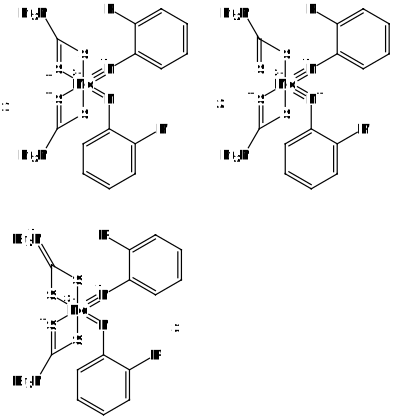
(more…)
Posted in Interesting chemistry | 2 Comments »