Introductory chemistry will tell us that a triple bond between say two carbon atoms comprises just one bond of σ-axial symmetry and two of π-symmetry. Increasingly mentioned nowadays is the possibility of a quadruple bond between carbon and either itself or a transition metal, as discussed in the previous post. Such a bond comprises TWO bonds of σ-axial symmetry. Since most people are unfamiliar with such double bonds and in particular with how that second σ-bond sits with the first, I thought it would be interesting to show such an orbital. This one is a localised orbital 41, selected from the previous post for the molecule (PH3)2(CN)2Mo⩸C. (more…)
Archive for the ‘Interesting chemistry’ Category
What does a double σ-bond along a bond axis look like?
Monday, May 10th, 2021Two new reality-based suggestions for molecules with a metal M⩸C quadruple bond.
Saturday, May 8th, 2021Following from much discussion over the last decade about the nature of C2, a diatomic molecule which some have suggested sustains a quadruple bond between the two carbon atoms, new ideas are now appearing for molecules in which such a bond may also exist between carbon and a transition metal atom. A suggested, albeit hypothetical example was C⩸Fe(CO)3[1]. Iron has a [Ar].3d6.4s2 electronic configuration and if we ionise to balance a C4- ligand, the iron becomes formally FeVI or [Ar].3d4. By adding 14 electrons deriving from the seven “bonds” to the 3d4, including a quadruple count from carbon, the Fe formally completes its 18-electron valence shell, as also found in e.g. Ferrocene.
References
- A.J. Kalita, S.S. Rohman, C. Kashyap, S.S. Ullah, and A.K. Guha, "Transition metal carbon quadruple bond: viability through single electron transmutation", Physical Chemistry Chemical Physics, vol. 22, pp. 24178-24180, 2020. https://doi.org/10.1039/d0cp03436c
Deltamethrin – a polymorphed insecticide.
Wednesday, March 24th, 2021Deltamethin is a pyrethroid insecticide for control of malaria which has been used for a little while. Perhaps inevitably, mosquitoes are developing resistance to it. So what could be done about countering this? Well, perhaps surprisingly, form a polymorph![1] These crystal structure isomers are often highly undesirable; thus Ritonavir, which changed its polymorphic form during manufacture to become far less active (due it has to be said to insolubility). Now a polymorph of Deltamethin has been discovered, which when applied as a powder, increases its effectiveness more than 10 times against Anopheles mosquitoes and provides a potentially new affordable malaria control solution for countries that are loosing protection.
References
- J. Yang, B. Erriah, C.T. Hu, E. Reiter, X. Zhu, V. López-Mejías, I.P. Carmona-Sepúlveda, M.D. Ward, and B. Kahr, "A deltamethrin crystal polymorph for more effective malaria control", Proceedings of the National Academy of Sciences, vol. 117, pp. 26633-26638, 2020. https://doi.org/10.1073/pnas.2013390117
The small-molecule antiviral compound Molnupiravir: an exploration of its tautomers.
Sunday, March 14th, 2021For obvious reasons, anti-viral molecules are very much in the news at the moment. Thus Derek Lowe highlights Molnupiravir which is shown as a hydroxylamine, the representation originating from the Wikipedia page on the molecule. 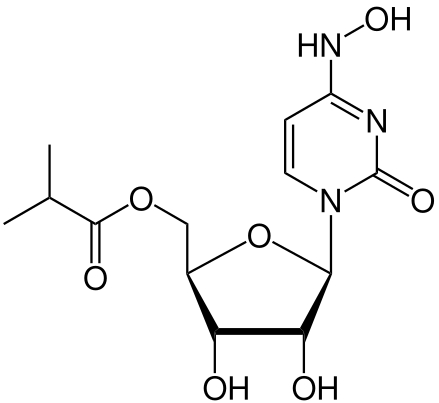
Non-covalent-interaction (NCI) surfaces for two large annulenes (revisited).
Sunday, February 7th, 2021The last post addressed the concept of “steric clashes” in a pericyclic reaction transition state as an extension of the time honoured practice of building molecular models to analyse reaction outcomes. A modern computer generated model might express this in terms of a NCI (non-covalent-interaction) surface. A few posts ago, I had looked at some “molecules of the year” for 2020, one of which was a “figure-eight” twisted dodecaporphyrin in which an aspect of the reported[1] geometry had struck me as potentially lacking features due to the so-called non-covalent dispersion or van der Waals attractions. So I am revisiting here by adding the NCI surface for this molecule and one other.
References
- M. Rickhaus, M. Jirasek, L. Tejerina, H. Gotfredsen, M.D. Peeks, R. Haver, H. Jiang, T.D.W. Claridge, and H.L. Anderson, "Global aromaticity at the nanoscale", Nature Chemistry, vol. 12, pp. 236-241, 2020. https://doi.org/10.1038/s41557-019-0398-3
The chemical synthesis of C2: another fascinating twist to the story.
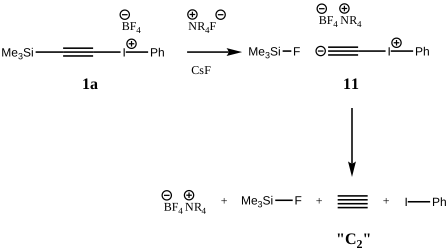
Wednesday, January 20th, 2021Last May, I wrote an update to the story sparked by the report of the chemical synthesis of C2.[1] This species has a long history of spectroscopic observation in the gas phase, resulting from its generation at high temperatures.[2] The chemical synthesis however was done in solution at ambient or low temperatures, a game-changer as they say. Here I give another update to this unfolding story.
References
- K. Miyamoto, S. Narita, Y. Masumoto, T. Hashishin, T. Osawa, M. Kimura, M. Ochiai, and M. Uchiyama, "Room-temperature chemical synthesis of C2", Nature Communications, vol. 11, 2020. https://doi.org/10.1038/s41467-020-16025-x
- T.W. Schmidt, "The Spectroscopy of C<sub>2</sub>: A Cosmic Beacon", Accounts of Chemical Research, vol. 54, pp. 481-489, 2021. https://doi.org/10.1021/acs.accounts.0c00703
The thermal reactions … took precisely the opposite stereochemical course to that which we had predicted
Wednesday, January 20th, 2021The quote of the post title comes from R. B. Woodward explaining the genesis of the discovery of what are now known as the Woodward-Hoffmann rules for pericyclic reactions.[1] I first wrote about this in 2012, noting that “for (that) blog, I do not want to investigate the transition states”. Here I take a closer look at this aspect.
References
- R.B. Woodward, and R. Hoffmann, "Stereochemistry of Electrocyclic Reactions", Journal of the American Chemical Society, vol. 87, pp. 395-397, 1965. https://doi.org/10.1021/ja01080a054
Dispersion attraction effects on the computed geometry of a leminscular dodecaporphyrin.
Friday, January 1st, 2021In the previous post, I showed the geometries of three large cyclic porphyrins, as part of an article[1] on exploring the aromaticity of large 4n+2 cyclic rings. One of them had been induced into a “figure-eight” or lemniscular conformation, as shown below.
References
- M. Rickhaus, M. Jirasek, L. Tejerina, H. Gotfredsen, M.D. Peeks, R. Haver, H. Jiang, T.D.W. Claridge, and H.L. Anderson, "Global aromaticity at the nanoscale", Nature Chemistry, vol. 12, pp. 236-241, 2020. https://doi.org/10.1038/s41557-019-0398-3
Global aromaticity at the nanoscale.
Thursday, December 31st, 2020Here is another of the “large” molecules in the c&e news shortlist for molecule-of-the-year, 2020. This one is testing the Hückel 4n+2 rule out to a value never before seen (n = 40, or 162 π-electrons).[1] The take-home message is that this rule seems to behave well in predicting global aromaticity even at this sort of scale!
References
- M. Rickhaus, M. Jirasek, L. Tejerina, H. Gotfredsen, M.D. Peeks, R. Haver, H. Jiang, T.D.W. Claridge, and H.L. Anderson, "Global aromaticity at the nanoscale", Nature Chemistry, vol. 12, pp. 236-241, 2020. https://doi.org/10.1038/s41557-019-0398-3
Tying different knots in a molecular strand.
Wednesday, December 30th, 2020The title derives from an article[1] which was shortlisted for the annual c&en molecule of the year 2020 awards (and which I occasionally cover here). In fact this year’s overall theme is certainly large molecules, the one exception being a smaller molecule with a quadruple bond to boron, a theme I have already covered here.
References
- D.A. Leigh, F. Schaufelberger, L. Pirvu, J.H. Stenlid, D.P. August, and J. Segard, "Tying different knots in a molecular strand", Nature, vol. 584, pp. 562-568, 2020. https://doi.org/10.1038/s41586-020-2614-0