As the title hints, I have been here before. The SN1 solvolysis mechanism of t-butyl chloride was central to the flourishing of physical organic chemistry from the 1920s onwards, and it appears early on in most introductory lecture courses and text books. There we teach that it is a two-stage mechanism. Firstly the C-Cl bond heterolyses to form a stable tertiary carbocation intermediate, which in a second stage reacts with nucleophile (water) to form e.g. t-butanol. This is contrasted with the SN2 mechanism, where these two stages are conflated into a single concerted process, involving no intermediates. Here I explore an intrinsic reaction coordinate for the hydrolysis of t-butyl chloride which attempts to tease out whether this simple picture is realistic.
The SN1 Mechanism for a third time. Exploration of the intrinsic reaction coordinate.
October 25th, 2011Science publishers (and authors) please take note.
October 24th, 2011I have for perhaps the last 25 years been urging publishers to recognise how science publishing could and should change. My latest thoughts are published in an article entitled “The past, present and future of Scientific discourse” (DOI: 10.1186/1758-2946-3-46). Here I take two articles, one published 58 years ago and one published last year, and attempt to reinvent some aspects. You can see the result for yourself (since this journal is laudably open access, and you will not need a subscription). The article is part of a special issue, arising from a one day symposium held in January 2011 entitled “Visions of a Semantic Molecular Future” in celebration of Peter Murray-Rust’s contributions over that period (go read all 15 articles on that theme in fact!).
Historical detective stories: colourful crystals.
October 21st, 2011Organic chemists have been making (more or less pure) molecules for the best part of 180 years. Occasionally, these ancient samples are unearthed in cupboards, and then the hunt for their origin starts. I have previously described tracking down the structure of a 120 year-old sample of a naphthalene derivative. But I visited a colleague's office today, and recollected having seen a well-made wooden display cabinet there on a previous visit. Today I took a photo of one of the samples:
The perception of stereochemistry. A challenging case.
October 18th, 2011Most representational chemistry generated on a computer requires the viewer to achieve a remarkably subtle transformation in their mind from two to three dimensions (we are not quite yet in the era of the 3D iPad!). The Cahn-Ingold-Prelog convention was a masterwork (which won the Nobel prize). It is shown in action for the molecule on the left below. The CIP notation was actually generated by Chemdraw, and required a fair sprinkling of wedged and hashed bonds to (try to) remove stereoambiguity and generate the labels (try it for yourself). As part of a lecture course on pericyclic reactions, I tell the students that the reaction involves a [1,3] sigmatropic migration of the red carbon and that this migration proceeds with inversion of configuration at this migrating carbon (as the selection rules require). Perceiving what the correct CIP product label should be (with inferred stereochemical labels, resolving ? into either R or S) is IMHO one of the most difficult conceptual experiences in all of organic chemistry. I have over the years struggled to find a way of revealing this in lecture notes (these struggles with the “lecture notes” will be the topic of a future post here). However, I think I may have finally cracked it; my solution is set out below!
Mechanism of the reduction of a carboxylic acid by borane: revisited and revised.
October 16th, 2011I asked a while back whether blogs could be considered a serious form of scholarly scientific communication (and so has Peter Murray-Rust more recently). A case for doing so might be my post of about a year ago, addressing why borane reduces a carboxylic acid, but not its ester, where I suggested a possible mechanism. Well, colleagues have raised some interesting questions, both on the blog itself and more silently by email to me. As a result, I have tried to address some of these questions, and accordingly my original scheme needs some revision! This sort of iterative process of getting to the truth with the help of the community (a kind of crowd-sourced chemistry) is where I feel blogs do have a genuine role to play.
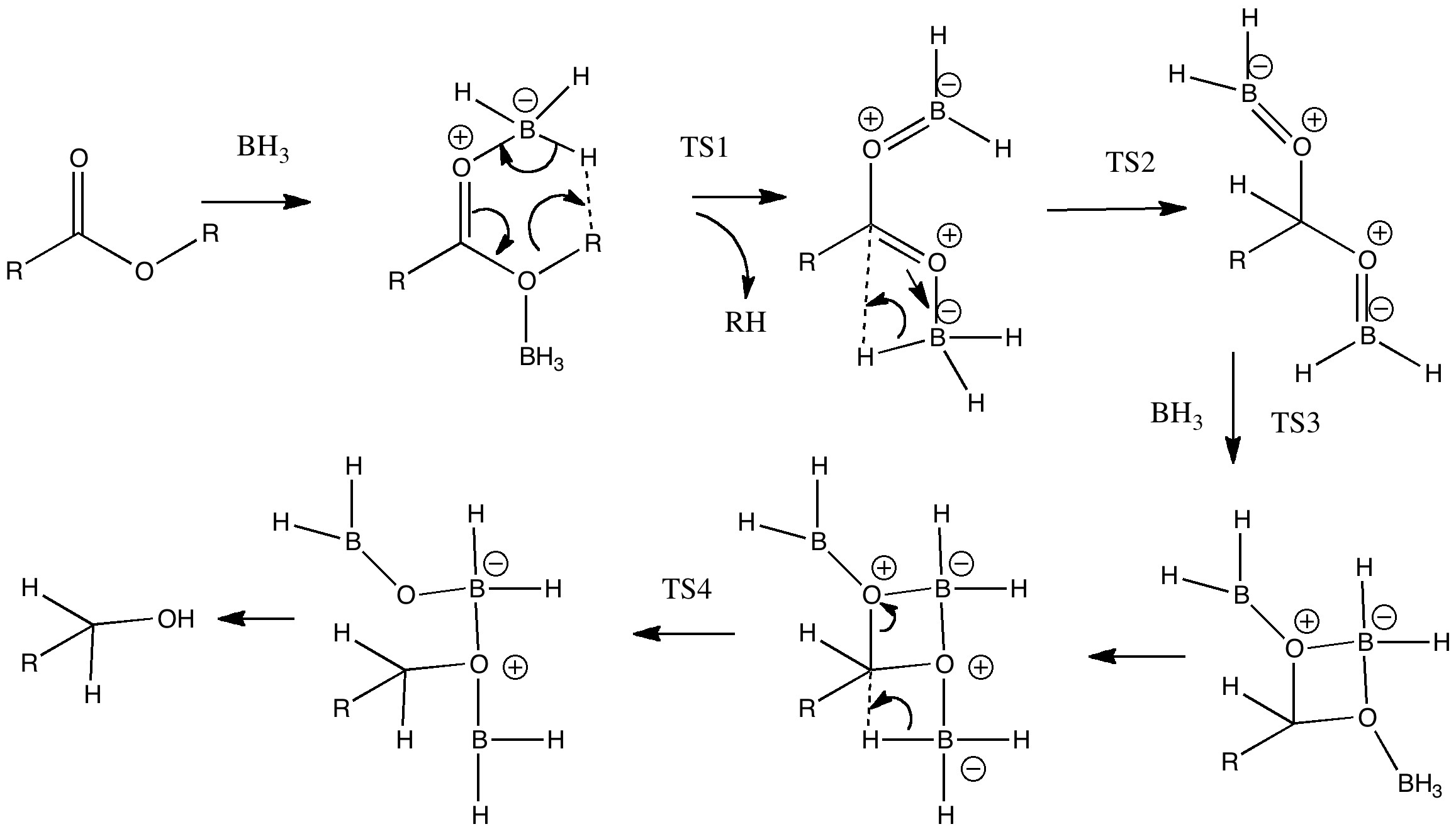
The reduction of a carboxylic acid by borane
Bonds.
October 13th, 2011Bonds are a good example of something all chemists think they can recognise when they see them. But they are also remarkably dependent on context. We are running a molecular modelling course at the moment, and I found myself explaining to someone how very context-sensitive they can be. I thought it might be useful to collect my thoughts here. Read the rest of this entry »
cis-Butene: a reaction coordinate dissected and methyl flags.
October 12th, 2011In two previous posts, I have looked at why cis-butene adopts conformation (a) rather than (b). I suggested it boiled down to electronic interactions between the methyl groups and the central alkene resulting in the formation of a H…H “topological” bond, rather than attraction between the H…H region to form a weak chemical “bond“. Here I take a look at what happens when that central C=C bond is gradually removed.
Are close H…H contacts bonds? The dénouement!
October 10th, 2011I wrote earlier about the strangely close contact between two hydrogen atoms in cis-butene. The topology of the electron density showed characteristics of a bond, but is it a consensual union? The two hydrogens approach closer than their van der Waals radii would suggest is normal, so something is happening, but that something need not be what chemists might choose to call a “bond“. An NCI (non-covalent analysis) hinted that any stability due to the electron topologic characteristics of a bond (the BCP) might be more than offset by the repulsive nature of the adjacent ring critical point (RCP). Here I offer an alternative explanation for why the two hydrogens approach so closely.
Steve Jobs and chemistry: a personal recollection.
October 9th, 2011Steve Jobs death on October 5th 2011 was followed by a remarkable number of tributes and reflections on the impact the company he founded has had on the world. Many of these tributes summarise the effect as a visionary disruption. Here I describe from my own perspective some of the disruptions to chemistry I experienced (for another commentary, see here).
Are close H…H contacts bonds?
October 7th, 2011The properties of electrons are studied by both chemists and physicists. At the boundaries of these two disciplines, sometimes interesting differences in interpretation emerge. One of the most controversial is that due to Bader (for a recent review, see DOI: 10.1021/jp102748b) a physicist who brought the mathematical rigor of electronic topology to bear upon molecules. The title of his review is revealing: “Definition of Molecular Structure: By Choice or by Appeal to Observation?”. He argues that electron density is observable, and that what chemists call a bond should be defined by that observable (with the implication that chemists instead often resort to arbitrary choice). Here I explore one molecule which could be said to be the focus of the differences between physics and chemistry; cis-but-2-ene.