August 17th, 2021
The homologous hydrocarbon series R4C is known for R=Me as neopentane and for R=Et as 3,3-diethylpentane. The next homologue, R=iPr bis(3,3-isopropyl)-2,4-dimethylpentane is also a known molecule[1] for which a crystal structure has been reported (DOI: https://doi.org/10.5517/cc4wvnh). The final member of the series, R= tbutyl is unknown. Here I have a look at some properties of the last two of these highly hindered hydrocarbons.
Read the rest of this entry »
References
- S.I. Kozhushkov, R.R. Kostikov, A.P. Molchanov, R. Boese, J. Benet-Buchholz, P.R. Schreiner, C. Rinderspacher, I. Ghiviriga, and A. de Meijere, "Tetracyclopropylmethane: A Unique Hydrocarbon with S4 Symmetry", Angewandte Chemie International Edition, vol. 40, pp. 180-183, 2001. https://doi.org/10.1002/1521-3773(20010105)40:1<180::aid-anie180>3.0.co;2-k
Posted in Interesting chemistry | No Comments »
August 15th, 2021
Whilst I was discussing the future of scientific publication in the last post, a debate was happening behind the scenes regarding the small molecule cyclopropenylidene. This is the smallest known molecule displaying π-aromaticity, but its high reactivity means that it is unlikely to be isolated in the condensed phase. A question in the discussion asked if substituting it with a large sterically hindering group such as R=Et3C might help prevent its dimerisation and hence allow for isolation of the monomer so that its properties can be studied.
Read the rest of this entry »
Posted in crystal_structure_mining, Interesting chemistry | 2 Comments »
August 13th, 2021
In 2011, I suggested that the standard monolith that is the conventional scientific article could be broken down into two separate, but interlinked components, being the story or narrative of the article and the data on which the story is based. Later in 2018 the bibliography in the form of open citations were added as a distinct third component.[1] Here I discuss an approach that has taken this even further, breaking the article down into as many as eight components and described as “Octopus publishing” for obvious reasons. These are;
Read the rest of this entry »
References
- D. Shotton, "Funders should mandate open citations", Nature, vol. 553, pp. 129-129, 2018. https://doi.org/10.1038/d41586-018-00104-7
Posted in Chemical IT | No Comments »
July 22nd, 2021
In the earlier post on the topic of anomeric effects, I identified a number of outliers associated with large differences in the lengths of two carbon-oxygen bonds sharing a common carbon atom.
Read the rest of this entry »
Posted in crystal_structure_mining | No Comments »
July 21st, 2021
In another post, a discussion arose about whether it might be possible to trap cyclopropenylidene to form a small molecule with a large dipole moment. Doing so assumes that cyclopropenylidene has a sufficiently long lifetime to so react, before it does so with itself to e.g. dimerise. That dimerisation has an energy profile shown below, with a free energy of activation of 14.4 kcal/mol, so a facile reaction that will indeed compete with reaction with Ph-I+-CC–. 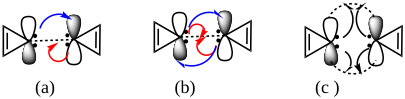
Read the rest of this entry »
Posted in Curly arrows, reaction mechanism | 4 Comments »
July 11th, 2021
Occasionally, someone comments about an old post here, asking a question. Such was the case here, when a question about the dipole moment of cyclopropenylidene arose. It turned out to be 3.5D, but this question sparked a thought about the related molecule below.
Read the rest of this entry »
Posted in Interesting chemistry | 6 Comments »
July 1st, 2021
The classic anomeric effect operates across a carbon atom attached to oxygens. One (of the two) lone pairs on the oxygen can donate into the σ* orbital of the C-O of the other oxygen (e.g. the red arrows) tending to weaken that bond whilst strengthening the donor oxygen C-O bond. Vice versa means e.g. the blue arrows weakening the other C-O bond. This effect tends to increase charge separation and the question then arises: how large can this effect get? To try to find out, we are going to do some crystal structure mining in this post! 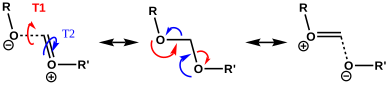
Read the rest of this entry »
Posted in crystal_structure_mining | No Comments »
June 2nd, 2021
From the last few posts here, you might have noticed much discussion about how the element carbon might sustain a quadruple bond. The original post on this topic from some years ago showed the molecular orbitals of the species CN+, which included two bonding π-types and a low lying nodeless bonding σ-orbital, all with double occupancies and adding up to a triple bond. Discussing now C2 itself, there are two remaining orbitals for consideration which we will for the purpose here call the highest occupied σ-MO or HOσMO (Σu) and the lowest unoccupied σ-MO or LUσMO (Σg) and which are more mysterious.
Read the rest of this entry »
Posted in Interesting chemistry | No Comments »
May 13th, 2021
I noted in an earlier post the hypothesized example of (CO)3Fe⩸C[1] as exhibiting a carbon to iron quadruple bond and which might have precedent in known five-coordinate metal complexes where one of the ligands is a “carbide” or C ligand. I had previously mooted that the Fe⩸C combination might be replaceable by an isoelectronic Mn⩸N pair which could contain a quadruple bond to the nitrogen. An isoelectronic alternative to FeC could also be FeN+. Here I explore the possibility of realistic candidates for such bonded nitrogen.
Read the rest of this entry »
References
- A.J. Kalita, S.S. Rohman, C. Kashyap, S.S. Ullah, and A.K. Guha, "Transition metal carbon quadruple bond: viability through single electron transmutation", Physical Chemistry Chemical Physics, vol. 22, pp. 24178-24180, 2020. https://doi.org/10.1039/d0cp03436c
Posted in crystal_structure_mining, Interesting chemistry | No Comments »
May 13th, 2021
The proposed identification of molecules with potential metal to carbon quadruple bonds, in which the metal exhibits trigonal bipyramidal coordination rather than the tetrahedral modes which have been proposed in the literature[1],[2],[3] leads on to asking whether simple trigonal coordination at the metal can also sustain this theme?
Read the rest of this entry »
References
- A.J. Kalita, S.S. Rohman, C. Kashyap, S.S. Ullah, and A.K. Guha, "Transition metal carbon quadruple bond: viability through single electron transmutation", Physical Chemistry Chemical Physics, vol. 22, pp. 24178-24180, 2020. https://doi.org/10.1039/d0cp03436c
- A.J. Kalita, S.S. Rohman, C. Kashyap, S.S. Ullah, I. Baruah, L.J. Mazumder, P.P. Sahu, and A.K. Guha, "Is a transition metal–silicon quadruple bond viable?", Physical Chemistry Chemical Physics, vol. 23, pp. 9660-9662, 2021. https://doi.org/10.1039/d1cp00598g
- L.F. Cheung, T. Chen, G.S. Kocheril, W. Chen, J. Czekner, and L. Wang, "Observation of Four-Fold Boron–Metal Bonds in RhB(BO<sup>–</sup>) and RhB", The Journal of Physical Chemistry Letters, vol. 11, pp. 659-663, 2020. https://doi.org/10.1021/acs.jpclett.9b03484
Posted in Interesting chemistry | No Comments »