I previously explored stabilized “carbenes” with the formal structures (R2N)2C:, concluding that perhaps the alternative ionic representation R2N+=C–NR2 might reflect their structures better. Here I take a broader look at the “carbene” landscape before asking the question “what about nitrenes?”
What’s in a name? Stabilised “nitrenes”.
September 19th, 2016Molecule orbitals as indicators of reactivity: bromoallene.
September 1st, 2016Bromoallene is a pretty simple molecule, with two non-equivalent double bonds. How might it react with an electrophile, say dimethyldioxirane (DMDO) to form an epoxide?[1] Here I explore the difference between two different and very simple approaches to predicting its reactivity. 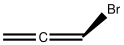
References
- D. Christopher Braddock, A. Mahtey, H.S. Rzepa, and A.J.P. White, "Stable bromoallene oxides", Chemical Communications, vol. 52, pp. 11219-11222, 2016. https://doi.org/10.1039/c6cc06395k
Journal innovations – the next step is augmented reality?
August 17th, 2016In the previous post, I noted that a chemistry publisher is about to repeat an earlier experiment in serving pre-prints of journal articles. It would be fair to suggest that following the first great period of journal innovation, the boom in rapid publication “camera-ready” articles in the 1960s, the next period of rapid innovation started around 1994 driven by the uptake of the World-Wide-Web. The CLIC project[1] aimed to embed additional data-based components into the online presentation of the journal Chem Communications, taking the form of pop-up interactive 3D molecular models and spectra. The Internet Journal of Chemistry was designed from scratch to take advantage of this new medium.[2] Here I take a look at one recent experiment in innovation which incorporates “augmented reality”.[3]
References
- D. James, B.J. Whitaker, C. Hildyard, H.S. Rzepa, O. Casher, J.M. Goodman, D. Riddick, and P. Murray‐Rust, "The case for content integrity in electronic chemistry journals: The CLIC project", New Review of Information Networking, vol. 1, pp. 61-69, 1995. https://doi.org/10.1080/13614579509516846
- S.M. Bachrach, and S.R. Heller, "The<i>Internet Journal of Chemistry:</i>A Case Study of an Electronic Chemistry Journal", Serials Review, vol. 26, pp. 3-14, 2000. https://doi.org/10.1080/00987913.2000.10764578
- S. Ley, B. Musio, F. Mariani, E. Śliwiński, M. Kabeshov, and H. Odajima, "Combination of Enabling Technologies to Improve and Describe the Stereoselectivity of Wolff–Staudinger Cascade Reaction", Synthesis, vol. 48, pp. 3515-3526, 2016. https://doi.org/10.1055/s-0035-1562579
A periodic table for anomeric centres, this time with quantified interactions.
August 8th, 2016The previous post contained an exploration of the anomeric effect as it occurs at an atom centre X for which the effect is manifest in crystal structures. Here I quantify the effect, by selecting the test molecule MeO-X-OMe, where X is of two types:
A periodic table for anomeric centres.
August 6th, 2016In the last few posts, I have explored the anomeric effect as it occurs at an atom centre X. Here I try to summarise the atoms for which the effect is manifest in crystal structures.
Stereoelectronic effects galore: bis(trifluoromethyl)trioxide.
August 4th, 2016Here is a little molecule that can be said to be pretty electron rich. There are lots of lone pairs present, and not a few electron-deficient σ-bonds. I thought it might be fun to look at the stereoelectronic interactions set up in this little system.
Anomeric effects at carbon involving lone pairs originating from one or two nitrogens.
July 8th, 2016The previous post looked at anomeric effects set up on centres such as B, Si or P, and involving two oxygen groups attached to these atoms. Here I vary the attached groups to include either one or two nitrogen atoms.[1]
References
- H. Rzepa, "Anomeric effects at carbon, involving lone pairs originating from one or two nitrogens", 2016. https://doi.org/10.14469/hpc/936