March 8th, 2011
The story of Monastral is not about a character in the Magic flute, but is a classic of chemical serendipity, collaboration between industry and university, theoretical influence, and of much else. Fortunately, much of that story is actually recorded on film (itself a unique archive dating from 1933 and being one of the very first colour films in existence!). Patrick Linstead, a young chemist then (he eventually rose to become rector of Imperial College) tells the story himself here. It is well worth watching, if only for its innocent social commentary on the English class system (and an attitude to laboratory safety that should not be copied nowadays). Here I will comment only on its colour and its aromaticity.
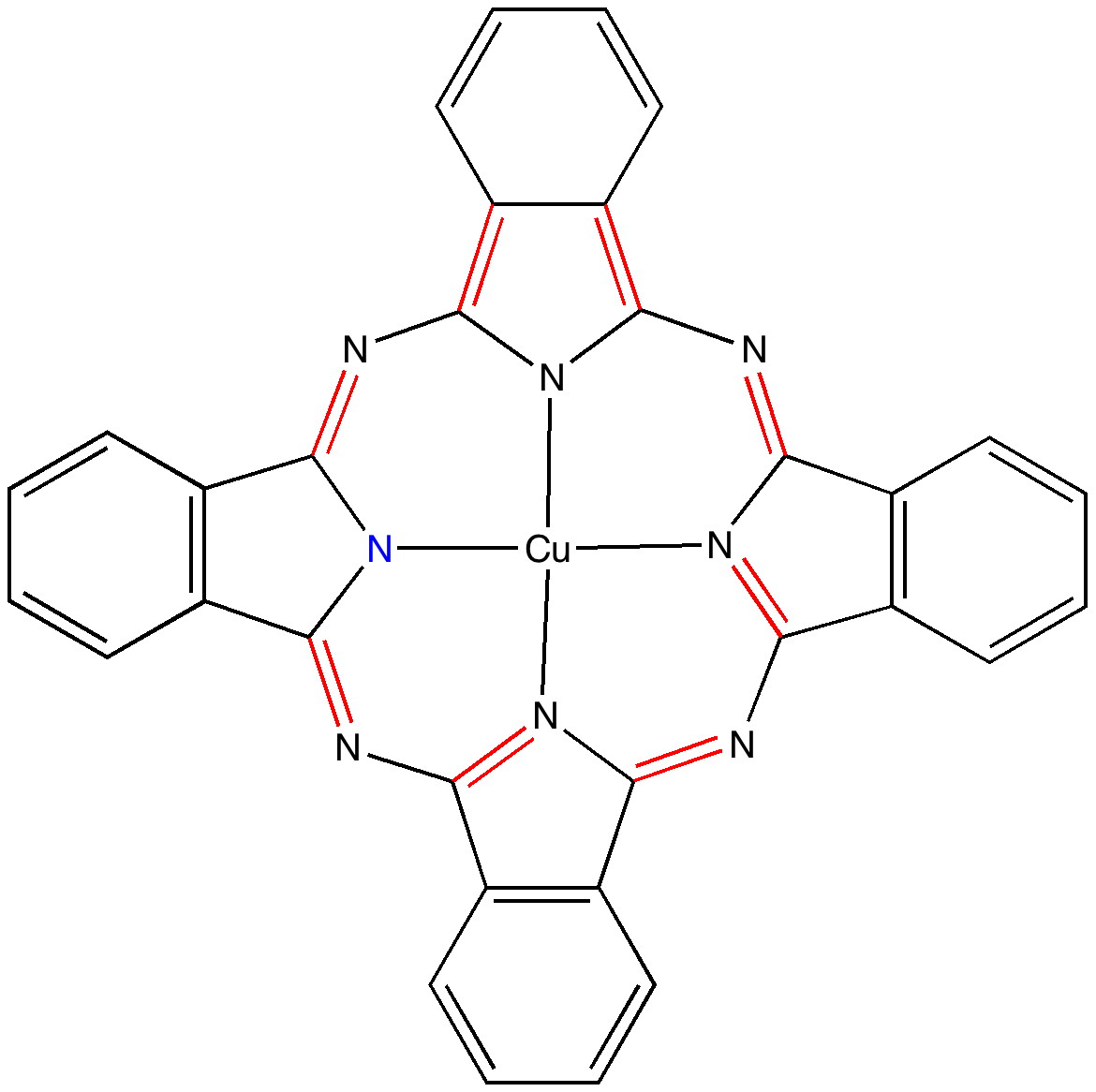
Copper phthalocyanine
Read the rest of this entry »
Tags: 18 electron aromaticity, chemical serendipity, Historical, HTML, HTML element, Imperial College, Missouri, Monastral blue, Patrick Linstead, phthalocyanine, Phthalocyanine Blue BN, Phthalocyanines, Pigments, rector, young chemist
Posted in Interesting chemistry | 6 Comments »
March 5th, 2011
In this earlier post, I noted some aspects of the calculated structures of both Z- and B-DNA duplexes. These calculations involved optimising the positions of around 250-254 atoms, for d(CGCG)2 and d(ATAT)2, an undertaking which has taken about two months of computer time! The geometries are finally optimised to the point where 2nd derivatives can be calculated, and which reveal up to 756 all-positive force constants and 6 translations and rotations which are close to zero! This now lets one compute the thermodynamic relative energies using ωB97XD/6-31G(d) (for 2nd derivatives) and 6-31G(d,p) (for dispersion terms). All geometries are optimized using a continuum solvent field (water), and are calculated, without a counterion, as hexa-anions. Read the rest of this entry »
Tags: 6-31G(d), ATAT duplex, B-DNA, CGCG duplex, dispersion energy corrections, energy, thermodynamic stability, Tutorial material, watoc11, wB97XD, Z-DNA
Posted in Interesting chemistry | 4 Comments »
March 5th, 2011
My colleague Bill Griffith has again come up with another colour challenge: that of the ancient semi-precious stone Lapis Lazuli, mined in the mountains of Afghanistan for more than 6000 years and used by painters in some medieval paintings of the Virgin, the Wilton diptych etc.
Read the rest of this entry »
Tags: Afghanistan, Bill Griffith, Lapis Lazuli, Missouri, trisulfide radical anion, Web browser
Posted in Interesting chemistry | 2 Comments »
March 1st, 2011
Much like chocolate, some of us metallaholics cannot get enough. So WUQXIP proved an irresistible frolic (DOI: 10.1021/om020789h). Let us start with benzene. It can have metals added in two ways, whilst preserving its essential aromaticity.
Read the rest of this entry »
Tags: Albrecht Salzer, Frank Podewils, Martin Kaupp, metal, metal delight, metal sandwich, metal-metal bond, metallabenzene, metallocene, three-centre bonding, triple metal bonding delight, Triple metal delight, Trixie Wagner, Ulli Englert, Ulrike Effertz
Posted in Hypervalency | No Comments »
February 24th, 2011
One of my chemical heroes is William Perkin, who in 1856 famously (and accidentally) made the dye mauveine as an 18 year old whilst a student of August von Hofmann, the founder of the Royal College of Chemistry (at what is now Imperial College London). Perkin went on to found the British synthetic dyestuffs and perfumeries industries. The photo below shows Charles Rees, who was for many years the Hofmann professor of organic chemistry at the very same institute as Perkin and Hofmann himself, wearing his mauveine tie. A colleague, who is about to give a talk on mauveine, asked if I knew why it was, well so very mauve. It is a tad bright for today’s tastes!
Read the rest of this entry »
Tags: August von Hofmann, Charles Rees, chemical heroes, chiroptical, colour, founder, Historical, Hofmann, HOMO, Imperial College, Imperial College London, LUMO, Mauveine, Perkin, professor of organic chemistry, purple, Rees, Royal College of Chemistry, William Perkin
Posted in General, Interesting chemistry | 16 Comments »
February 13th, 2011
The Möbius band is an experimental delight. In its original forms, it came flat-packed as below. The one shown on the left is related to the international symbol for recycling (if we denote the number of half twists imparted as m, this one has m=3). The middle one (m=4) shows a 4-twisted variant, and the one on the right has a 5-twist (m=5). These all come from Möbius’ original sketches, found amongst his belongings when he died. In this post they will form the basis for some experiments in molecular chirality.
Read the rest of this entry »
Tags: chemical analogy, chemical term, Möbius, pre-biotic, RNA, Tutorial material, Valentine
Posted in General | 1 Comment »
February 5th, 2011
In 1953, the model of the DNA molecule led to what has become regarded as the most famous scientific diagram of the 20th century. It had all started 93 years earlier in 1860, at a time when the tetravalency of carbon was only just established (by William Odling) and the concept of atoms as real entities was to remain controversial for another 45 years (for example Faraday, perhaps the most famous scientist alive in 1860 did not believe atoms were real). So the idea of constructing a molecular model from atoms as the basis for understanding chemical behaviour was perhaps bolder than we might think. It is shown below, part of a set built for August Wilhelm von Hofmann as part of the lectures he delivered at the Royal College of Chemistry in London (now Imperial College).
Read the rest of this entry »
Tags: and compare the two, chemical behaviour, deficiency, Hermann Sachse, Historical, Hofmann, Imperial College, Josef Loschmidt, Loschmidt, model, modern model, molecular model, Odling, Royal College of Chemistry, Royal College of Chemistry in London, Sachse, scientist, Tutorial material, Wilhelm von Hofmann, William Odling
Posted in General | 3 Comments »
January 21st, 2011
Much of chemistry is about bonds, but sometimes it can also be about anti-bonds. It is also true that the simplest of molecules can have quite subtle properties. Thus most undergraduate courses in chemistry deal with how to describe the bonding in the diatomics of the first row of the periodic table. Often, only the series C2 to F2 is covered, so as to take into account the paramagnetism of dioxygen, and the triple bonded nature of dinitrogen (but never mentioning the strongest bond in the universe!). Rarely is diberyllium mentioned, and yet by its strangeness, it can also teach us a lot of chemistry.
Read the rest of this entry »
Tags: diberyllium, energy, excited state, higher energy, higher energy state, pence, Tutorial material
Posted in Interesting chemistry | 6 Comments »
January 14th, 2011
In my blogroll, I link to Tim Gowers’ blog. He is a very eminent mathematician, and so it is interesting to see what motivates him to write a blog about mathematics. This latest post goes a large way to explaining why. He starts by speculating about the features of some piece of research that might render it conventionally unpublishable, highlighting two reasons; (1) it is not original and (2) it does not lead anywhere conclusive. He then goes on to show how either outcome might nevertheless be useful to someone, even if unpublishable conventionally. The rest of his post then concentrates on the cap-set problem in pure mathematics. It boils down to the observation that the community as a whole might often spot something that individual might have a blind spot for. Or, that others may in turn be inspired by lines of research which had apparently led nowhere for the original poster. Tim of course is favoured by having often 80+ comments appended to each of his posts!
Read the rest of this entry »
Tags: chemical literature, DNA, eminent mathematician, helix, left handed, right handed, Tim Gowers
Posted in General | No Comments »