May 10th, 2015
Blogging in chemistry remains something of a niche activity, albeit with a variety of different styles. The most common is commentary or opinion on the scientific literature or conferencing, serving to highlight what their author considers interesting or important developments. There are even metajournals that aggregate such commentaries. The question therefore occasionally arises; should blogs aspire to any form of permanence, or are they simply creatures of their time.
Read the rest of this entry »
Tags: author, chemical information, Digital Object Identifier, the JCE journal, the Journal of Chemical Education
Posted in Chemical IT | 5 Comments »
April 26th, 2015
Allotropes are differing structural forms of the elements. The best known example is that of carbon, which comes as diamond and graphite, along with the relatively recently discovered fullerenes and now graphenes. Here I ponder whether any of the halogens can have allotropes.
Read the rest of this entry »
Tags: Allotropy, Bromine, Carbon, Chemical elements, Chemistry, free energy barrier, Fullerene, Halogen, Hypobromite, Matter, Nonmetals, Oxidizing agents, Oxygen, pence
Posted in reaction mechanism | 9 Comments »
April 21st, 2015
Egon has reminded us that adoption of ORCID (Open researcher and collaborator ID) is gaining apace. It is a mechanism to disambiguate (a Wikipedia term!) contributions in the researcher community and to also remove much of the anonymity (where that is undesirable) that often lurks in social media sites.
Read the rest of this entry »
Tags: Chemoinformatics, George Orwell, Gravatar, journal submission systems, online publications, Open researcher, researcher, social media sites, Yevgeny Zamyatin
Posted in Chemical IT | 3 Comments »
April 17th, 2015
The knowledge that substituents on a benzene ring direct an electrophile engaged in a ring substitution reaction according to whether they withdraw or donate electrons is very old.[1] Introductory organic chemistry tells us that electron donating substituents promote the ortho and para positions over the meta. Here I try to recover some of this information by searching crystal structures.
Read the rest of this entry »
References
- H.E. Armstrong, "XXVIII.—An explanation of the laws which govern substitution in the case of benzenoid compounds", J. Chem. Soc., Trans., vol. 51, pp. 258-268, 1887. https://doi.org/10.1039/ct8875100258
Tags: above search, Aromatic compounds, aromaticity, Birch reduction, Chemistry, electron donating, Electrophile, Electrophilic aromatic substitution, Ether, Functional groups, little search, Organic chemistry, Physical organic chemistry, Substitution reactions
Posted in Chemical IT, crystal_structure_mining | 1 Comment »
April 12th, 2015
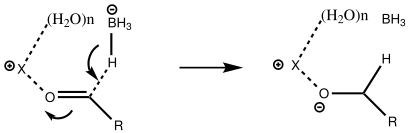
Tags: aqueous solution, Chemical bond, chemical bonding, Chemistry, Electronic effect, energy, final product, free energy barrier, Hydride, Hydrogen bond, immediate product, Lithium aluminium hydride, reduction
Posted in reaction mechanism | 2 Comments »
April 10th, 2015
Previously on this blog: modelling the reduction of cinnamaldehyde using one molecule of lithal shows easy reduction of the carbonyl but a high barrier at the next stage, the reduction of the double bond. Here is a quantum energetic exploration of what might happen when a second LAH is added to the brew (the usual ωB97XD/6-311+G(d,p)/SCRF=diethyl ether).
Read the rest of this entry »
Tags: computed free energy barrier, energy, energy surface, final product, flat energy potential, free energy, lower energy pathways, metal exchange, pence, potential energy surface, reduction, Yes
Posted in reaction mechanism | No Comments »
April 8th, 2015
Last August, I wrote about data galore, the archival of data for 133,885 (134 kilo) molecules into a repository, together with an associated data descriptor[1] published in the new journal Scientific Data. Since six months is a long time in the rapidly evolving field of RDM, or research data management, I offer an update in the form of some new observations.
Read the rest of this entry »
References
- R. Ramakrishnan, P.O. Dral, M. Rupp, and O.A. von Lilienfeld, "Quantum chemistry structures and properties of 134 kilo molecules", Scientific Data, vol. 1, 2014. https://doi.org/10.1038/sdata.2014.22
Tags: API, RCSB Protein Data Bank, search engine
Posted in Chemical IT | No Comments »
April 1st, 2015
The reduction of cinnamaldehyde by lithium aluminium hydride (LAH) was reported in a classic series of experiments[1],[2],[3] dating from 1947-8. The reaction was first introduced into the organic chemistry laboratories here at Imperial College decades ago, vanished for a short period, and has recently been reintroduced again.‡ The experiment is really simple in concept; add LAH to cinnamaldehyde and you get just reduction of the carbonyl group; invert the order of addition and you additionally get reduction of the double bond. Here I investigate the mechanism of these reductions using computation (ωB97XD/6-311+G(d,p)/SCRF=diethyl ether).
Read the rest of this entry »
References
- R.F. Nystrom, and W.G. Brown, "Reduction of Organic Compounds by Lithium Aluminum Hydride. I. Aldehydes, Ketones, Esters, Acid Chlorides and Acid Anhydrides", Journal of the American Chemical Society, vol. 69, pp. 1197-1199, 1947. https://doi.org/10.1021/ja01197a060
- R.F. Nystrom, and W.G. Brown, "Reduction of Organic Compounds by Lithium Aluminum Hydride. II. Carboxylic Acids", Journal of the American Chemical Society, vol. 69, pp. 2548-2549, 1947. https://doi.org/10.1021/ja01202a082
- F.A. Hochstein, and W.G. Brown, "Addition of Lithium Aluminum Hydride to Double Bonds", Journal of the American Chemical Society, vol. 70, pp. 3484-3486, 1948. https://doi.org/10.1021/ja01190a082
Tags: Al-H-Li bridge, dihydrocinnamyl alcohol reduction product, free energy, Imperial College, independent researcher, low energy escape route, lower energy alternative, metal, pence
Posted in reaction mechanism | 5 Comments »
March 20th, 2015
This might be seen as cranking a handle by producing yet more examples of acids ionised by a small number of water molecules. I justify it (probably only to myself) as an exercise in how a scientist might approach a problem, and how it linearly develops with time, not necessarily in the directions first envisaged. A conventional scientific narrative published in a conventional journal tells the story often with the benefit of hindsight, but rarely how the project actually unfolded chronologically.‡ So by devoting 7 posts to this, you can judge for yourself how my thoughts might have developed (and I am prepared to acknowledge this may only serve to show my ignorance).
Read the rest of this entry »
Tags: Mt. Everest, scientist
Posted in Interesting chemistry | No Comments »
March 17th, 2015
I do not play poker,‡ and so I had to look up a 5-4-3-2-1(A), which Wikipedia informs me is a 5-high straight flush, also apparently known as a steel wheel. In previous posts I have suggested acids which can be ionised by (probably) 5, 4, 3 or 1 discrete water molecules in the gas phase; now to try to track down a candidate for ionisation by the required two water molecules to form that straight flush.
Read the rest of this entry »
Tags: free energy, gas phase, steel wheel
Posted in Interesting chemistry | No Comments »