Molecules of Life
Biochemists have been dealing with molecules for over 150 years, but the modern era is generally recognised as starting in 1944 with the discovery by Oswald, et al. of the "transforming principle" - the factor which controls inheritance - in other words the genetic material Deoxyribonucleic acid, DNA.
This chapter deals with the four major molecules of life, Carbohydrates, Nucleic acids, Lipids and Proteins.
Carbohydrates
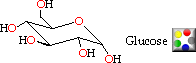
Carbohydrates are organic molecules comprised of carbon, hydrogen and oxygen, and as their name suggests they can be considered as hydrates of carbon - eg. consider glucose, which has the formula C6H12O6 and can also be written as C6(H2O)6. Glucose is a constituent of many important biopolymers including starch and cellulose.